![[Translate to Englisch:]](/fileadmin/_processed_/6/d/csm_innovating_2023_89b6c6e6ac.jpg)
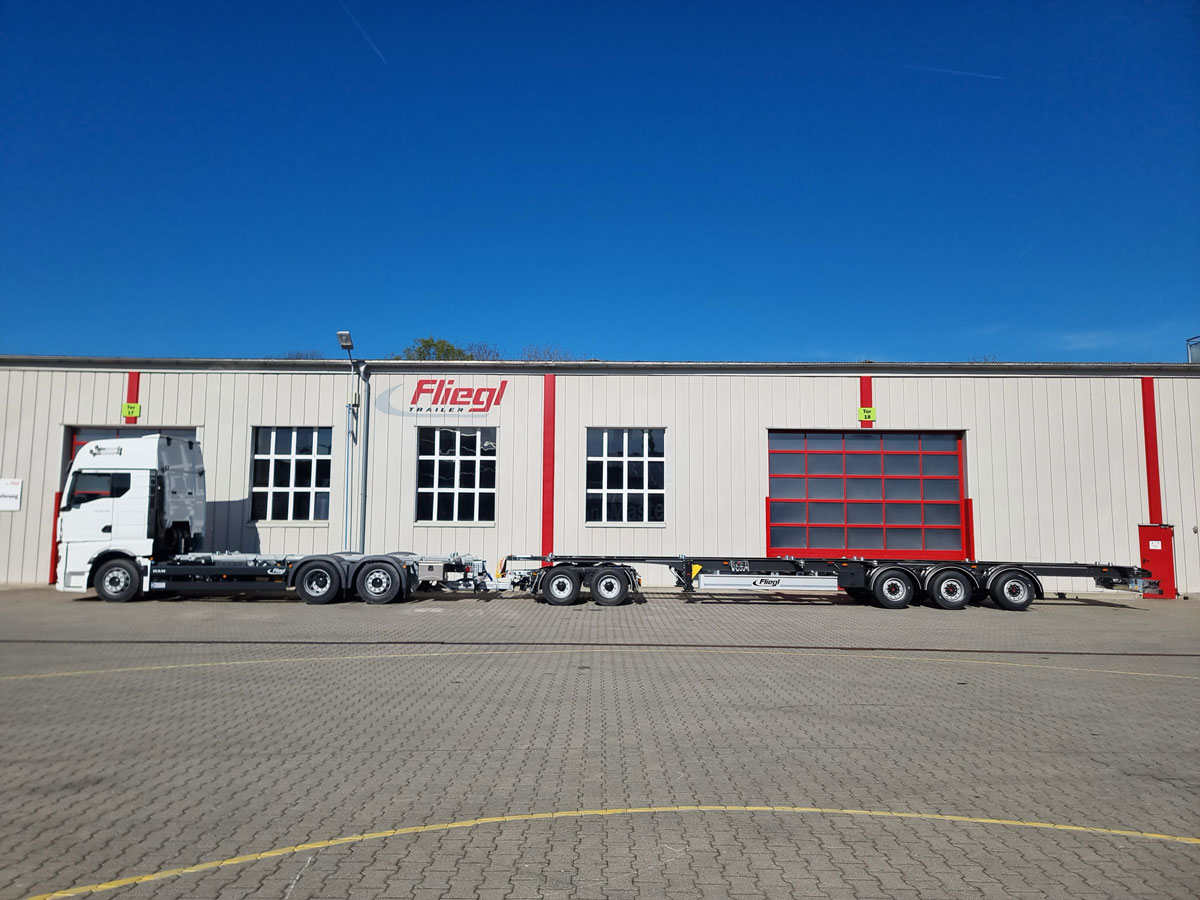
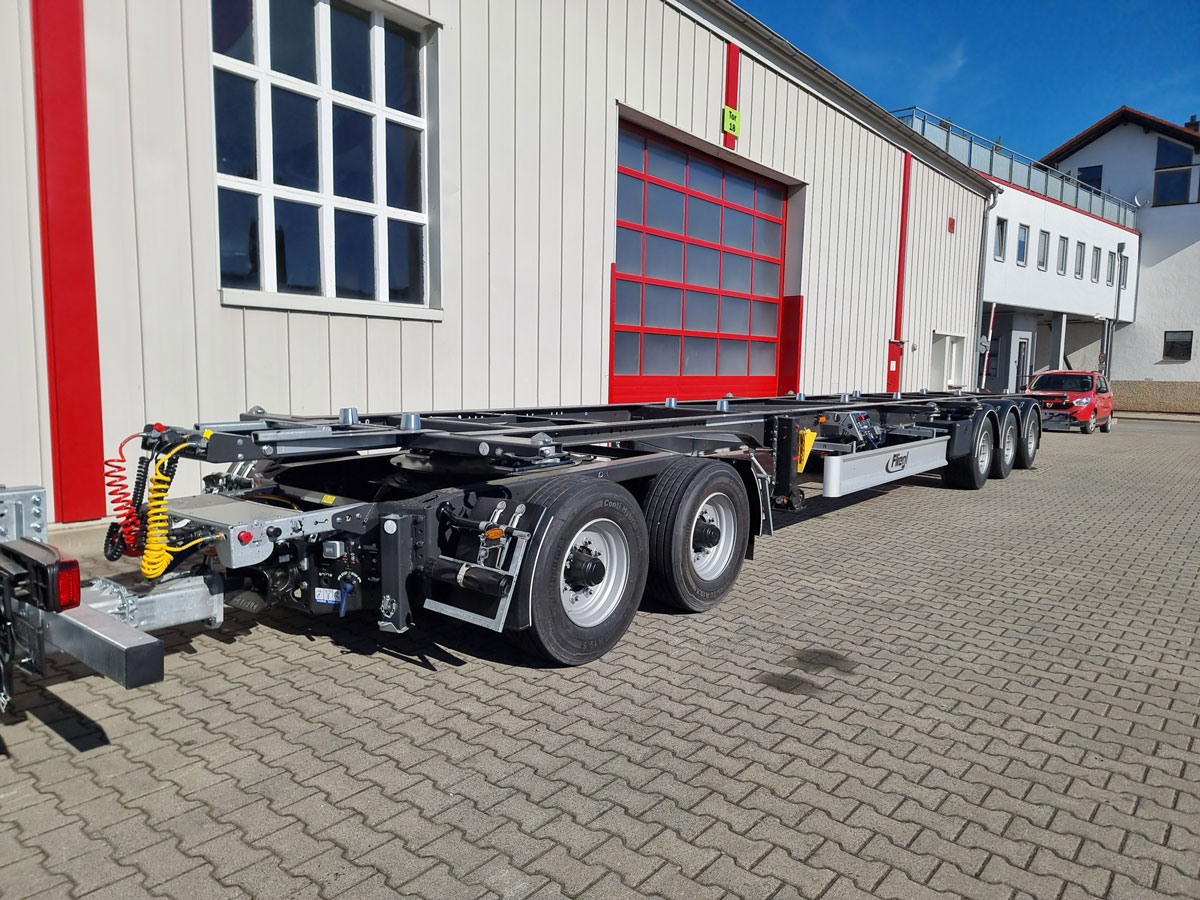
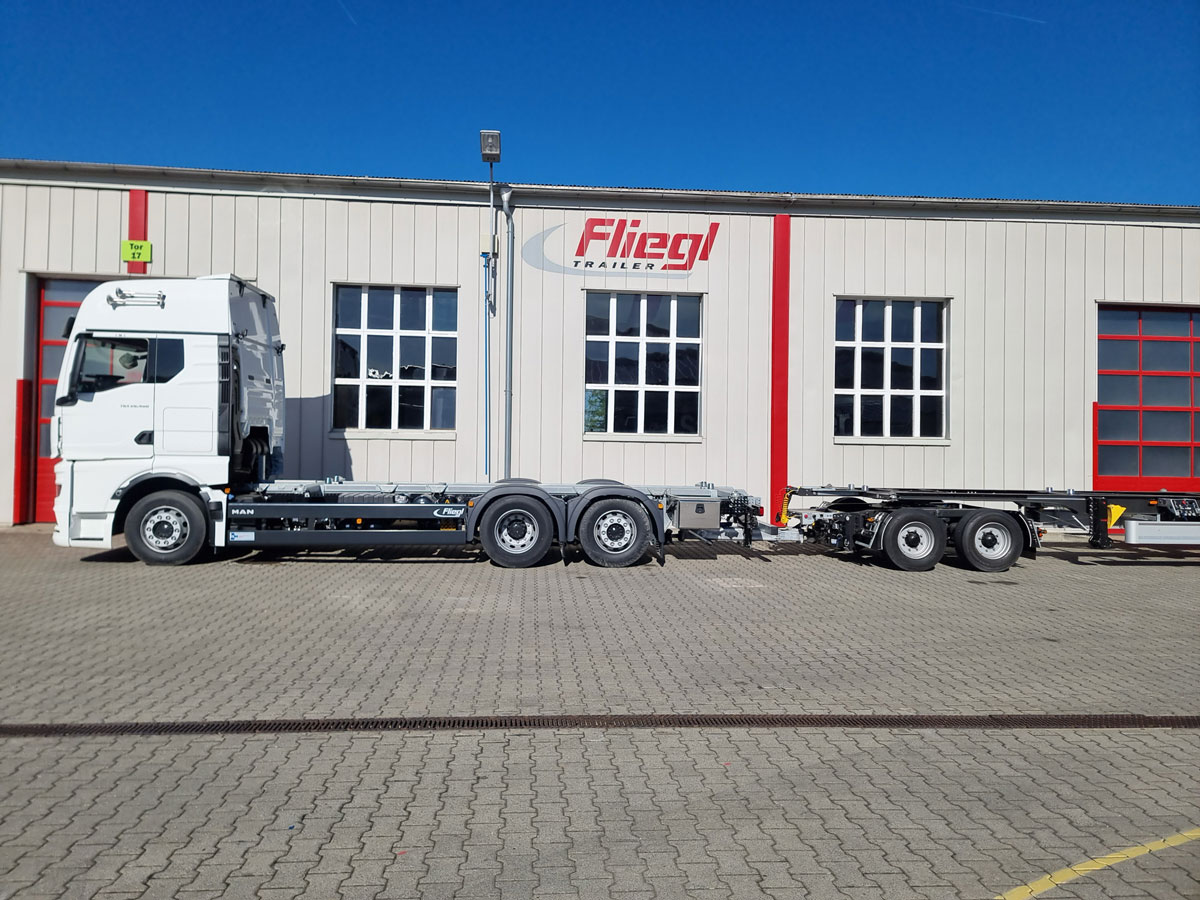
Schüller Möbelwerk GmbH, based in Herrieden, Bavaria, sends swap body lorries on the road four times a week to Venlo in the Netherlands, some 500 kilometres away. Two drivers take turns, covering just under 1,000 kilometres a day – almost 190,000 kilometres a year. With such enormous distances, maximum efficiency is key. “We work exclusively with swap bodies for our own-account transport and ended up with Fliegl two years ago because we can transport three swap bodies per journey with a long-haul lorry,” says fleet manager Tobias Rummel. The long-haul lorry consists of the tractor unit, the CLG dolly and a three-axle SDS 380 Mega X-tra long semi-trailer.
Furniture and kitchens are relatively light goods, where transport is mainly a matter of volume. The more items of furniture that can be transported per journey, the fewer journeys are needed: three 7.45-metre swap bodies instead of two mean 50 per cent greater efficiency and 30 per cent lower fuel consumption per swap body. For Schüller, this also means 90 fewer journeys per year – which is good for the bottom line and the environment.
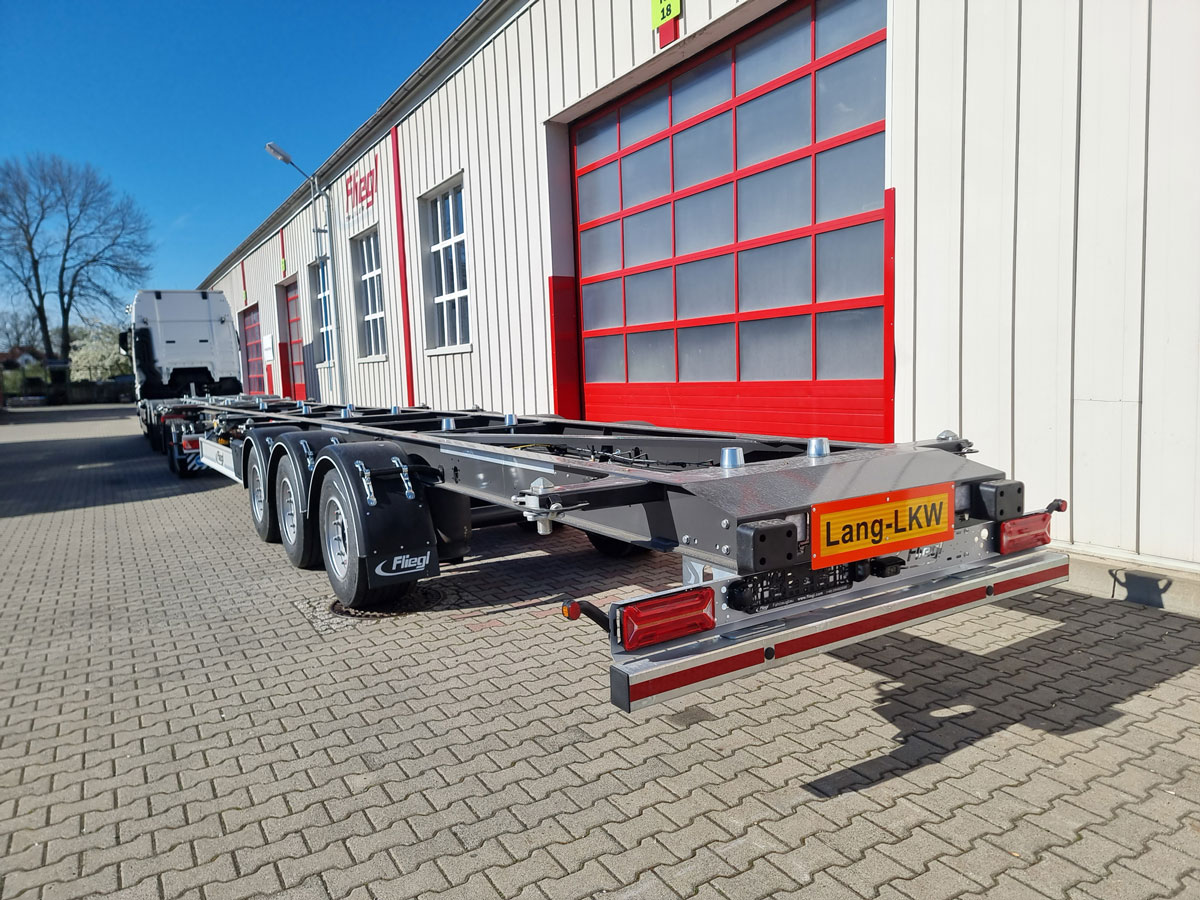
The container semi-trailer chassis features 8 container locks on sturdy brackets, which accommodate two 20-foot containers/swap bodies. Six pairs of guide rollers facilitate under-running; the stop is plug-in at the front and foldable in the centre. With an unladen weight of just 4,312 kilograms, the Swap-Train semi-trailer offers a permissible payload of 29,888 kilograms, sufficient even for heavy swap bodies beyond furniture transport. Thanks to a slightly offset wheelbase (1,310/1,410 millimetres), the gross combination weight in combined transport may be up to 44 tonnes. To ensure the gross vehicle weight is not accidentally exceeded, the vehicle is fitted with an axle load detection system complete with a display in the cab, which receives data from the EBS CAN bus signal. Like every axle that leaves the factory in Triptis, the three SAF disc-brake axles are also perfectly measured and adjusted using laser technology. This reduces rolling resistance and ensures lower fuel consumption and tyre wear.
Seeing and being seen are particularly important with a long-haul lorry. Fliegl therefore fits two additional LED work lights at the rear; a reversing camera system with a colour monitor ensures safety when manoeuvring. Two further LED spotlights are mounted at the front and centrally between the beams to make it easier to navigate in the dark. The rear lights are LED, as are the side lights linked to the indicators. At Schüller, ensuring that everything on the vehicle functions smoothly is the responsibility of Jörg Busch, head of the company’s own vehicle maintenance department.
Long-haul lorries are only permitted to travel on certain routes in Germany, but that is not a problem, says Tobias Rummel: “On the motorway, this is usually not an issue, and in the Netherlands, long-haul lorries can use over 70% of the road network. So it’s a perfect fit for our regular service to Venlo.” The swap body trucks are expected to cover around 1 million kilometres for Schüller before they are replaced. For long-distance journeys, that means after around five and a half years. After that, their second life continues, thanks to a ten-year warranty against rust-through of the painted frame.
Fuel economy has been a priority not just since the extremely high diesel prices of recent weeks; in any case, a significant portion of the TCO is accounted for by fuel costs. “We are certainly considering adding another long-haul truck to the fleet,” reports Tobias Rummel. This would be a good decision, as only Fliegl offers 30 per cent lower fuel consumption per swap body.
INNOVATING FOR YOU: Sustainable production, sustainable vehicles
Fliegl prioritises sustainability right from the start in the manufacture of trailers and semi-trailers for the construction, haulage and logistics sectors. Design, production and assembly all take place at a single central site, eliminating the need for CO2-emitting transport between factories over long distances. Fliegl’s modern trailer plant in Thuringia has a positive energy balance – electricity production exceeds its own consumption. Fliegl operates two combined heat and power plants and has installed large-scale photovoltaic systems; heating is provided by wood chips and waste wood.
The vehicles are painted in a highly efficient, resource-saving facility; energy-intensive baking processes are not required. To further reduce energy consumption, Fliegl has invested in pulse welding machines and fibre laser systems and has completely converted the hall lighting to LED. The new high-bay warehouse feeds the energy used back into the cycle. When purchasing vehicle components, Fliegl ensures that full truckloads are procured, so that deliveries are always made at optimal capacity.
Fliegl’s vehicle concepts are based on a sustainable product philosophy. Lightweight construction is a top priority, enabling Fliegl to achieve best-in-class trailer weights – to the benefit of payload and CO₂ emissions. The Fliegl Quick Lock System enhances aerodynamics on curtain-sided trailers. It does away with protruding locking buckles, creating a completely flat tarpaulin surface. Fliegl tipper trailers are built as standard with an aerodynamic conical body and a curved chassis featuring a rounded, extremely flat frame neck – the tipper does not protrude beyond the tractor unit. Wind deflectors and the innovative membrane rear wall also reduce air resistance. Only Fliegl adjusts the track of every trailer individually and precisely using a laser – for lower rolling resistance and reduced tyre wear. Fliegl’s twin-axle curtain-sided semi-trailers significantly reduce fuel consumption and toll costs compared to three-axle models.
Ecology and sustainability – Fliegl Trailer takes it seriously. Fliegl Trailer was awarded the German Sustainability Prize 2016 for its holistic approach to resource efficiency.