![[Translate to Englisch:]](/fileadmin/_processed_/6/d/csm_innovating_2023_89b6c6e6ac.jpg)
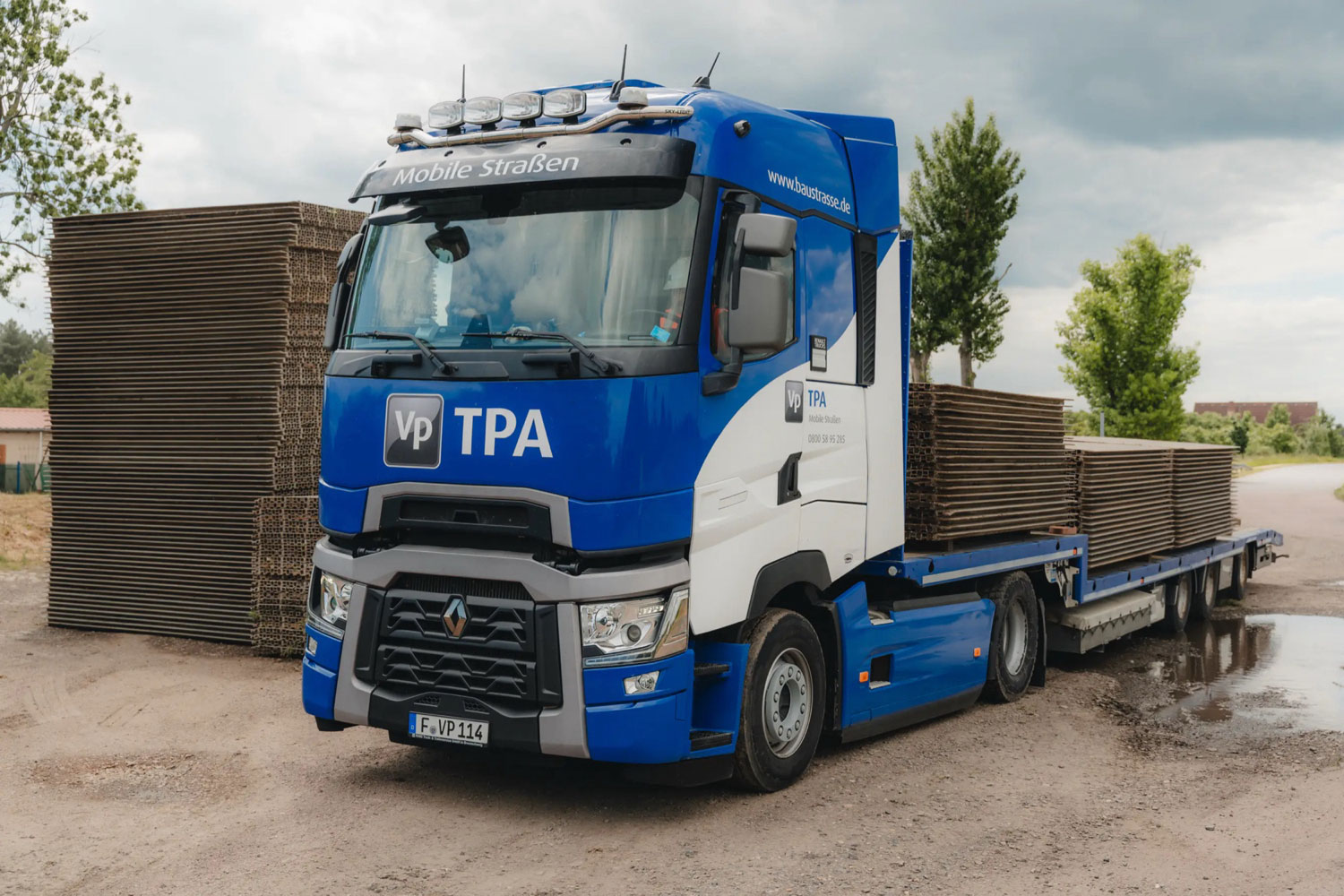
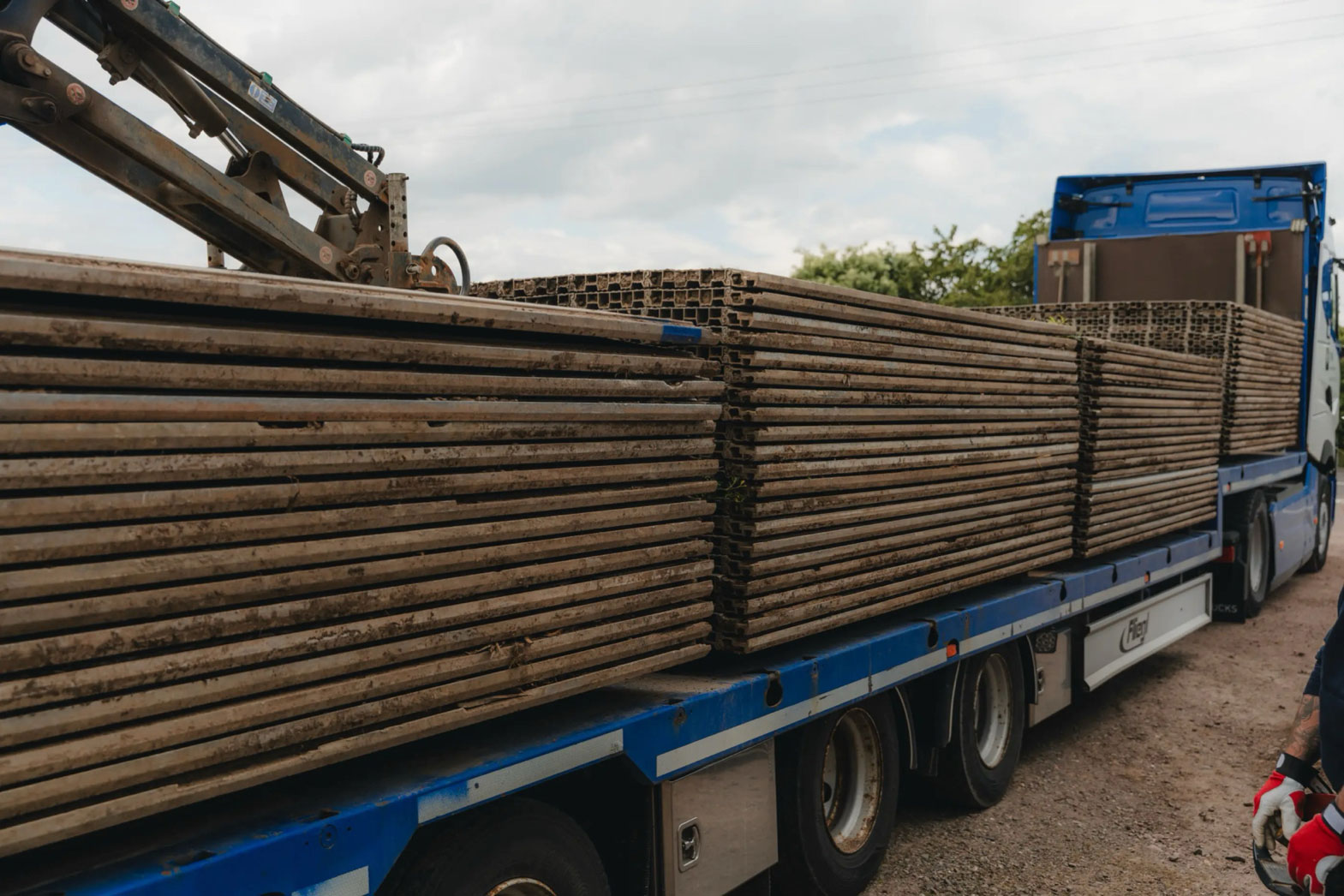
TPA recently put new Volvo lorries into service. For several years now, the company has also relied on Fliegl vehicles; it currently operates two SDS 390 flatbed semi-trailers and three SDS 410 Jumbo flatbed semi-trailers with a sloping rear. Thomas Thumulla is responsible for the technical development of the fleet at TPA; he reports: “Securing the panels was particularly important to us, which is why we have a large number of stanchion pockets and lashing points on board.” The SDS 410 offers 12 stanchion pockets in the outer frame, four of which are on the cradle and eight in the deep bed; these are supplemented by a further 16 stanchion pockets on the outside of the main frame. 20 lashing bolts, each with a tensile force of 10,000 daN, and 20 lashing eyes, each with a tensile force of 5,000 daN, provide plenty of lashing options. In combination with plug-in stanchions and crossbars, Vario end walls can also be used. “We discussed the stanchion positions in detail with the sales representative to ensure they would suit the various loads,” reports Thumulla. When not in use, the plug-in stanchions are stored in a storage compartment on the end wall.
The other features of the SDS 410 are also perfectly suited to TPA’s transport requirements. For instance, the low-loader offers a high point load of 26,000 kilograms over just 4 metres in length at the centre of gravity; the permissible payload is 27,100 kilograms. The SDS 390 flatbed semi-trailer can even handle a permissible payload of around 29,000 kilograms.
Thanks to the 900-millimetre-long rear bevel, the low-loader, in combination with the 2,400-millimetre-long aluminium ramps, provides a shallow approach angle. “This means we can also load forklift trucks and are therefore independent of other haulage companies. We also transport the excavator with the plate clamp using the semi-trailer,” explains Thomas Thumulla. Tensioning straps or chains are stored in the two stainless steel storage boxes or in the large side storage compartment when not in use.
The longitudinally laid hardwood floor, made from robust Finnish timber, is 30 millimetres thick; the so-called omega profiles underneath ensure high point load-bearing capacity on the SDS 410. On the SDS 390 flatbed semi-trailer, the longitudinal cross-members allow a forklift axle load of 7,100 kilograms.
On both the SDS 390 and the SDS 410, the first axle is designed as an automatic lift axle. Up to a speed of 25 km/h and with an axle load exceeding the limit by 30%, the axle can be raised, thereby shifting more weight onto the fifth wheel plate – this ensures greater traction on the drive axle. To ensure good manoeuvrability on tight construction sites, the rear axle of the SDS 410 features self-steering with an automatic reverse lock via the reversing light; additionally, the lock function can be activated via a manual button on the vehicle. As is standard with Fliegl, all axles are precisely measured by laser and set to within ±1 millimetre ex-works, ensuring low tyre wear and reduced fuel consumption.
Drivers cover around 110,000 kilometres per year with the trailers, almost exclusively in Germany, but also across Europe. A long trailer life is guaranteed, as Fliegl offers a 10-year warranty against rust-through on the painted frame.